
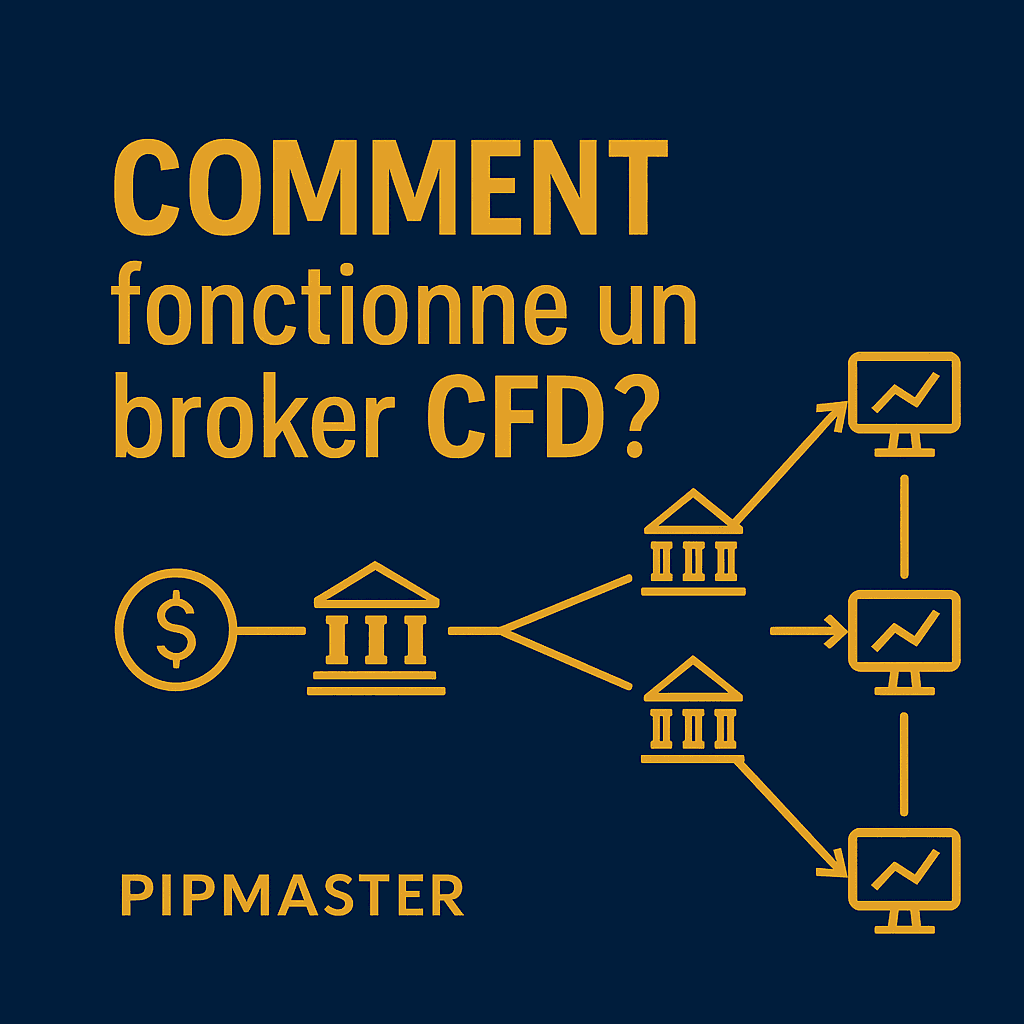
CFD brokers are the gateway to the market for millions of retail traders.
But few really know how a CFD broker works, how they make money, or how they execute orders.
Understanding all this is like understanding the rules of a game before you bet your money.
And in trading, whoever understands the mechanics always has an advantage.
💡 What are CFDs?
A CFD (Contract for Difference) is a contract between you and your broker:
You don't own the asset (such as a share, currency or commodity), but only speculate on the price difference between the opening and closing of your position.
If the market moves in your direction → You win!
If it moves against you → You lose!
This model allows you to trade with leverage, so you can mobilize little capital to control a larger position.
But this power must be used with caution, as it amplifies both gains and losses.
⚙️ The role of the CFD broker
The CFD broker plays a dual role:
- Provide a trading platform (MT5, cTrader, WebTrader...)
- Execute your market orders, directly or indirectly.
But beware: not all brokers work in the same way.
And this is where things get interesting.
🧩 The two main families of brokers
1️⃣ Market Maker (or dealing desk)
These brokers create their own internal market.
When you buy, they sell, and when you sell, they buy.
They take the other side of your position.
- ✅ Advantage: Fast turnaround, often fixed spreads.
- ⚠️ Disadvantage: Potential conflict of interest, as your gain is their loss.
But beware: this doesn't mean they're "cheating".
Good Market Makers partially hedge on the real market, and manage flows globally.
2️⃣ ECN / STP (No Dealing Desk)
These brokers transmit your orders directly to liquidity providers (banks, funds, institutions).
They take no position against you.
- ✅ Advantage: Transparency, real market execution.
- ⚠️ Disadvantage: Variable spreads, higher commissions.
In short: The Market Maker creates the market,
the ECN participates in it.
💰 How does a CFD broker make money?
Three main sources:
| Source of income | Description | Example |
|---|---|---|
| Spread | Difference between Ask and Bid prices | EURUSD: 1.0700 / 1.0702 = 2 pips spread |
| Commission | Fixed fee per lot (often charged by ECN brokers) | 6 per round-trip lot |
| Overnight financing (swap) | Interest rate applied if you keep a position open overnight | Positive or negative depending on the pair |
💡 Titan Breakout, for example, checks the maximum (user-defined) spread before each execution, to avoid entering expensive or unstable markets.
This is essential protection against those invisible micro costs.
🔒 Regulation: Your shield of trust
Before you trade, check that your broker is regulated.
A reputable broker is supervised by a recognized financial authority:
- 🇬🇧 FCA (United Kingdom)
- 🇫🇷 AMF (France)
- 🇩🇪 BaFin (Germany)
- 🇨🇾 CySEC (Cyprus)
- 🇦🇺 ASIC (Australia)
These organizations require :
- Segregation of customer funds,
- Minimum capital requirements,
- And regular checks to prevent abuse.
👉 A regulated broker cannot use your money for its internal operations.
📉 Why brokers limit leverage in Europe
ESMA (European Securities and Markets Authority) has imposed strict caps since 2018:
- 1:30 for major pairs (EURUSD, GBPUSD...)
- 1:20 for minor pairs
- 1:10 for raw materials
This limitation is designed to protect individual traders from over-exposure.
And that's a good thing: Leverage, when misused, destroys more accounts than it enriches.
📊 Order execution: What really happens
When you click on "Buy" in MetaTrader, this is what happens:
- Your order is sent to the broker's server
- It is either :
- Execute instantly (Market Maker),
- Or routed to a liquidity provider (ECN/STP).
- The system validates price, volume and spread.
- The order is confirmed on your terminal.
This process is played out in milliseconds.
But a poor infrastructure or server overload can cause slippage (execution at a less favorable price).
Titan Breakout limits this with its spread and global mutex checks, which prevent simultaneous execution on multiple symbols.
🧠 How to choose your CFD broker
Here's a simple but formidable checklist:
✅ Broker régulé (AMF, FCA, ASIC, CySEC…)
✅ Compte segregated (fonds séparés du capital de l’entreprise)
✅ Spreads faibles et stables
✅ Exécution rapide (idéalement < 100 ms)
✅ Support client réactif
✅ Compatibilité MT5 (indispensable pour Titan Breakout)
And above all: Always test on a demo account before depositing.
It's free, and the best insurance against unpleasant surprises.
🚀 The link with Titan Breakout
A good EA can only be successful if the broker is sound.
Titan Breakout relies on accurate execution and a controlled spread. Two points that depend directly on the quality of the broker.
Even the best system in the world will never compensate for a poorly executed broker.
That's why Pipmaster recommends that you always validate the strategy + execution environment pairing before switching to a live account.
🧭 Conclusion: Your broker is your partner on the road
Choosing a broker isn't like choosing a brand of coffee.
It's choosing the engine that will drive your strategy forward.
A good CFD broker does not guarantee success,
, but a bad broker does guarantee failure.
And in the world of retail trading,
understanding the mechanics is already mastering them.
🔗 Discover Titan Breakout
👉 S ee Titan Breakout on Pipmaster.co.uk
The EA MT5 H1-only designed to fit all reliable broker environments, with total spread and risk control.