
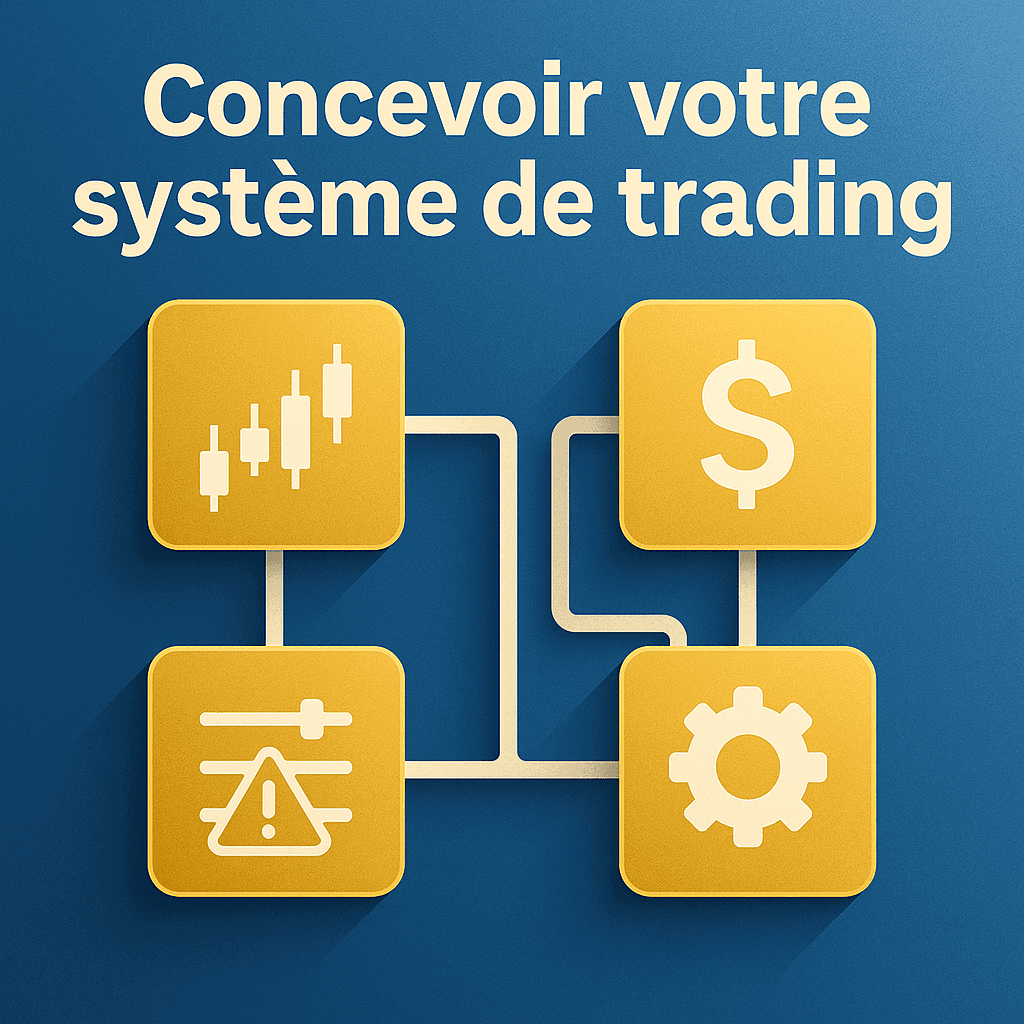
Designing your trading system: Method, structure and discipline
Many traders launch out without a plan, chaining indicators together, and changing strategy at the slightest setback.
But those who succeed know one thing: sustainable profitability doesn't come from a miraculous signal, but from a coherent system.
A good trading system is a set of tools, rules and parameters that transforms market complexity into simple, measurable and repeatable decisions.
In other words: reliable mechanics, not emotional roulette.
⚙️ 1️⃣ The foundations of a good system
A high-performance trading system rests on three pillars:
- A clear market logic: Understand why you enter the market
- A strict methodology: Know how you get in
- Rigorous risk management: Define how much you risk
Each element depends on the previous one.
You can have the best signal in the world, but without consistent money management, your account will always end up extinguished.
This is exactly the hierarchy followed by Titan Breakout Logic → Conditions → Execution → Risk control.
📈 2️⃣ Define your market logic
Before coding or executing anything, you need to answer this question:
What am I trying to capture?
- A trend?
- A breakout?
- A reversion after excess?
The system Titan Breakout for example, is built around a breakout logic:
looks for breaks validated by the underlying trend, filtered by volatility and the strength of the movement (ADX, RSI, EMA).
Your logic must therefore be simple, measurable and consistent with your trading style (scalping, swing, intraday...).
🧮 3️⃣ Choosing the right indicators
There's no need to overload your chart.
Three good indicators are enough to create a solid base:
- EMA: To visualize the dominant trend.
- RSI: To filter out emotional excesses.
- ATR: To adjust Stop Loss and Take Profit to volatility.
There's nothing random about this trio: it's the very heart of the Titan Breakout engine, which relies on the coherence between D1 and H1 timeframes and ATR-tuned dynamic parameters.
A good system doesn't try to anticipate everything, but to identify the moments when risk is justified.
💰 4️⃣ Parameterizing risk: the sinews of war
Without Risk Management, your system is worthless.
Every parameter of your plan must be thought out in terms of risk.
A few basic rules:
- Risk_Percent: Determines how much of your capital you risk per trade. (e.g.: 0.5% to 1%).
- SL_ATR and TP_ATR: Set the distance between stops and targets according to volatility.
- BE_Trigger_ATR: triggers the break-even once the price has risen by a certain margin.
- TS_Trigger_ATR / TS_Distance_ATR: Activate an intelligent trailing stop.
👉 These parameters, available in Titan Breakoutembody the Risk Management philosophy:
Protect capital before seeking to multiply it.
⏰ 5️⃣ The time factor: When your system needs to act
Not all markets are created equal.
A system must define when it is authorized to trade.
With variables like StartTime and EndTime, you can limit trading to periods that are liquid and consistent with your strategy.
This avoids off-peak times (end of Asian session, beginning of week) when false signals abound.
A good system also knows when not to trade.
🧩 6️⃣ Check correlation and overall load
If your system takes several positions on related pairs (e.g. EURUSD, GBPUSD, EURJPY), you risk doubling your exposure without realizing it.
That's why Titan Breakout incorporates an anti-correlation filter: it prevents the simultaneous opening of positions with common currencies in the same direction.
Result: Your risk remains globally under control, even if several signals appear at the same time.
🧠 7️⃣ Document, test, improve
A system is not set in stone.
It must evolve with the market.
Test it on several pairs and several years.
Analysis :
- The Profit Factor
- The Drawdown
- And consistent results
Titan Breakout, for example, was backtested on hundreds of configurations before being validated on real FTMO accounts.
Every parameter was adjusted to maintain a balance between performance and stability.
The aim is not to do better than yesterday, but to understand why yesterday was better.
🚀 To sum up
Designing your system is like building a rocket:
Every bolt counts, but it's the overall coherence that determines whether it will reach orbit.
- 🎯 Clarify your market logic
- ⚙️ Structure your indicators around a precise objective
- 💰 Manage your risk with discipline
- 🧩 Avoid correlations
- 🔄 Test, adjust, document
And if you want to see what a system entirely thought out with this logic looks like, take a look at Titan Breakout. An EA designed as a modular architecture of performance and discipline.