
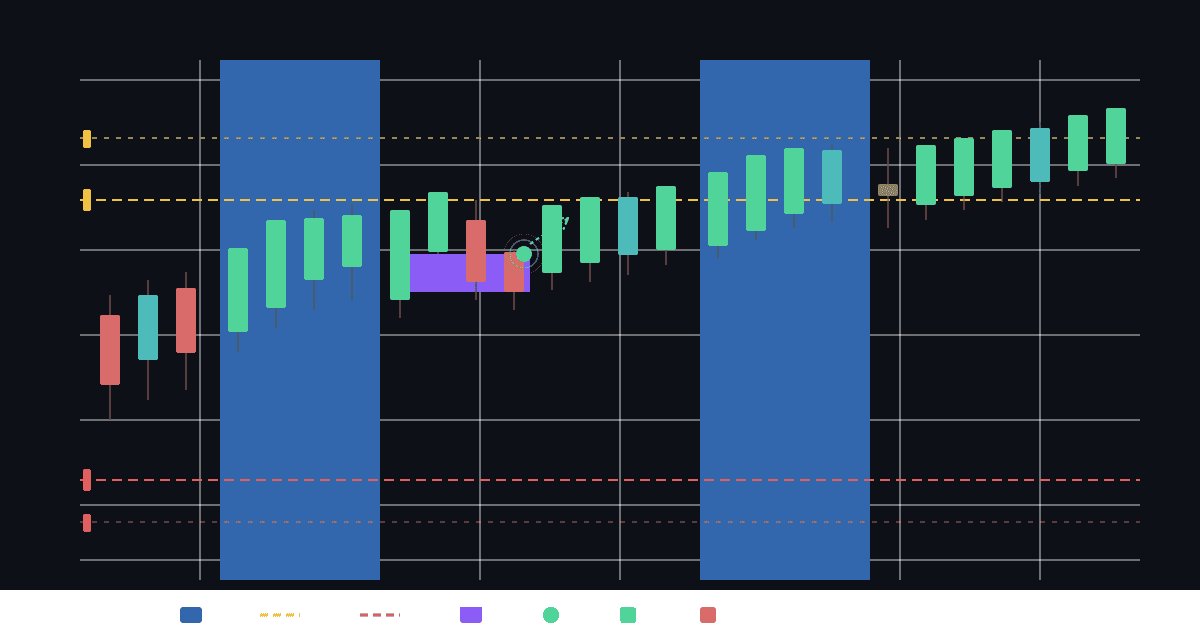
Institutional filters in an Expert Advisor: Kill Zones, Structural Levels, and FVG
An Expert Advisor that generates signals without considering market context is like an EA shooting in the dark. Price movements are not random:
It reacts at specific levels, during specific time windows, when liquidity from major players is concentrated.
Incorporating this reality into the logic of an EA is exactly what institutional filters do.
That is why they are essential in any serious automated trading system.
Why a raw signal isn't enough
Most Expert Advisors operate on a simple principle:
When an indicator crosses a threshold, a trade is executed. This approach completely ignores the context in which the signal appears.
However, two identical signals on the same asset can lead to radically different outcomes depending on the time they occur, the price’s position relative to key market levels, and the quality of the entry point itself.
The philosophy is simple: Trade less, but trade better. Fewer, more carefully selected trades. Capital preservation comes first.
Filter 1 – Kill Zones: Trading at the Right Times
The Problem with 24/7 Trading
The Forex market is open almost around the clock, but not all times are created equal.
During off-peak hours, liquidity is low, spreads widen, and price movements are often erratic.
A breakout that occurs at 3 a.m. in the EUR/USD pair is statistically much less likely to continue than a breakout at 9 a.m., when the London market opens.
What is a Kill Zone?
A Kill Zone is a time window that coincides with the opening of a major financial market.
It is at these moments that institutional investors enter the market in large numbers, generating the liquidity needed for a trend to develop and sustain itself.
| Session | Default window | Key Markets |
|---|---|---|
| Asia (Tokyo) | 2:00 a.m. – 4:00 a.m. | JPY, AUD, NZD, XAU |
| London (opening) | 8:00 a.m. – 10:00 a.m. | EUR, GBP, CHF: The busiest session in the Forex market |
| New York (overlap) | 1:00 PM – 4:00 PM | USD: Highest liquidity of the day |
| Market Close in New York | 7:00 p.m. – 8:00 p.m. | Year-end reversals and adjustments |
The three optimal configuration modes
FILTER Mode (recommended): Any signal outside the Kill Zone is immediately rejected, regardless of its technical quality. The EA only enters trades during periods of high liquidity.
BOOST Mode: Signals are accepted at any time, but when execution occurs in the Kill Zone, the stop-loss is reduced (e.g., by 25%). The risk-reward ratio is improved during active sessions without blocking others.
OFF Mode: Kill Zones are disabled. The EA can enter at any time. Not recommended for most breakout strategies.
An important technical detail: Double-checking
A well-designed EA checks the Kill Zone at two distinct points: on the signal, and then at the time of execution.
If the EA is waiting for a retest and the Kill Zone expires in the meantime, the order is not executed.
This double-check ensures consistency between the filter logic and the order actually sent to the broker.
Filter 2 – Structural Levels: Avoiding Liquidity Walls
PDH, PDL, PWH, PWL: What are we talking about?
- PDH (Previous Day High): The highest price reached during the previous trading day
- PDL (Previous Day Low): The lowest price of the previous trading day
- PWH (Previous Week High): The high for the previous closed week
- PWL (Previous Week Low): The lowest price of the previous trading week
These levels are not just horizontal lines.
These represent areas where major institutional reforms are pending.
Banks and funds use them systematically to set their entry points, stop-loss orders, and take-profit orders.
Why can these levels prevent a trade from going through?
Imagine a LONG signal on EUR/USD:
Technically valid: Donchian channel broken, EMAs aligned, ADX confirmed. But the price is 15 pips below yesterday’s high, a level the market has not yet broken through.
This PDH poses a real obstacle:
Institutional sellers could step in on a massive scale and reverse the trend. Entering this market entails a structural risk that technical signals alone do not reveal.
The logic of the structural filter
The filter calculates the distance between the current price and each resistance level in multiples of the ATR, to account for the instrument’s volatility.
If the price is too close to an unbroken level in the opposite direction, the signal is rejected. For a volatile asset, the buffer zone is naturally wider. For a calm asset, it is narrower.
Filter 3 – Fair Value Gaps: A Specific Entry Point
What is a fair value gap?
A Fair Value Gap (FVG) is an area of imbalance created by three consecutive 15-minute candlesticks with no overlap between the first and third.
There is a price gap that the market did not fill during the initial price movement.
These zones attract price action because unfilled orders are waiting there. Waiting for this retest rather than entering immediately on the breakout offers two concrete advantages:
- A better entry price: Often following a slight pullback after a breakout
- A tighter stop-loss: Calculated from the bottom (LONG) or the top (SHORT) of the FVG zone rather than as a multiple of the raw ATR. The risk-reward ratio is automatically improved
The three possible ways to use it
FVG_OFF: Disabled. The EA starts immediately after the signal is confirmed.
FVG_OPTIONAL (recommended for beginners):
The EA uses the FVG if it finds one in recent M15 candlesticks. If it doesn't find one within the specified time window, it enters immediately. Balanced mode.
FVG_STRICT:
The FVG is mandatory. Without a valid FVG, the signal is invalidated. More selective mode. Should be validated via backtesting before live trading.
The Three Combined Filters: A Layered Approach
The real power lies not in each filter taken individually, but in their combination.
Each layer independently reduces the range of valid signals:
The Kill Zone validates the session context, the structural filter verifies the absence of institutional barriers, and the FVG optimizes the entry point.
A signal that passes all three criteria was selected across three distinct dimensions.
That’s the difference between an EA that trades on anything that moves and a system that waits until the conditions are objectively met.
To see how this architecture fits into the overall decision-making process, visit the page explaining how Titan Breakout works.
Practical Application: What This Means in Practice
Fewer trades, no decline in performance
The first reaction to additional filters is often: “I’m going to miss out on opportunities.”
That's true. But the opportunities that get filtered out are precisely the ones that are most likely to backfire on you.
A filterless EA can generate 50 trades per month.
With Kill Zones, a structural filter, and FVG_OPTIONAL, this number can drop to 15–20, with a significantly higher success rate and risk-reward ratio.
Compatibility with prop firms
Prop firms evaluate the consistency and robustness of a system, not just its raw performance.
A selective EA with low daily drawdown and low variance is, by definition, more likely to pass a challenge than an aggressive EA without context.
Institutional filters directly contribute to protecting against daily drawdowns. This is one of the rules most strictly monitored by evaluators.
Conclusion
Institutional filters are not just gimmicks.
They are the algorithmic representation of a market reality:
Prices move in response to market participants whose behavior is partially predictable, within specific time frames and around levels that can be identified in advance.
An Expert Advisor that incorporates this logic operates with a level of market intelligence that the vast majority of general-purpose EAs lack.
To learn how Kill Zones, structural levels, and FVG interact in practice with the H1 Donchian signal and position management, visit the Titan Breakout How It Works page.