
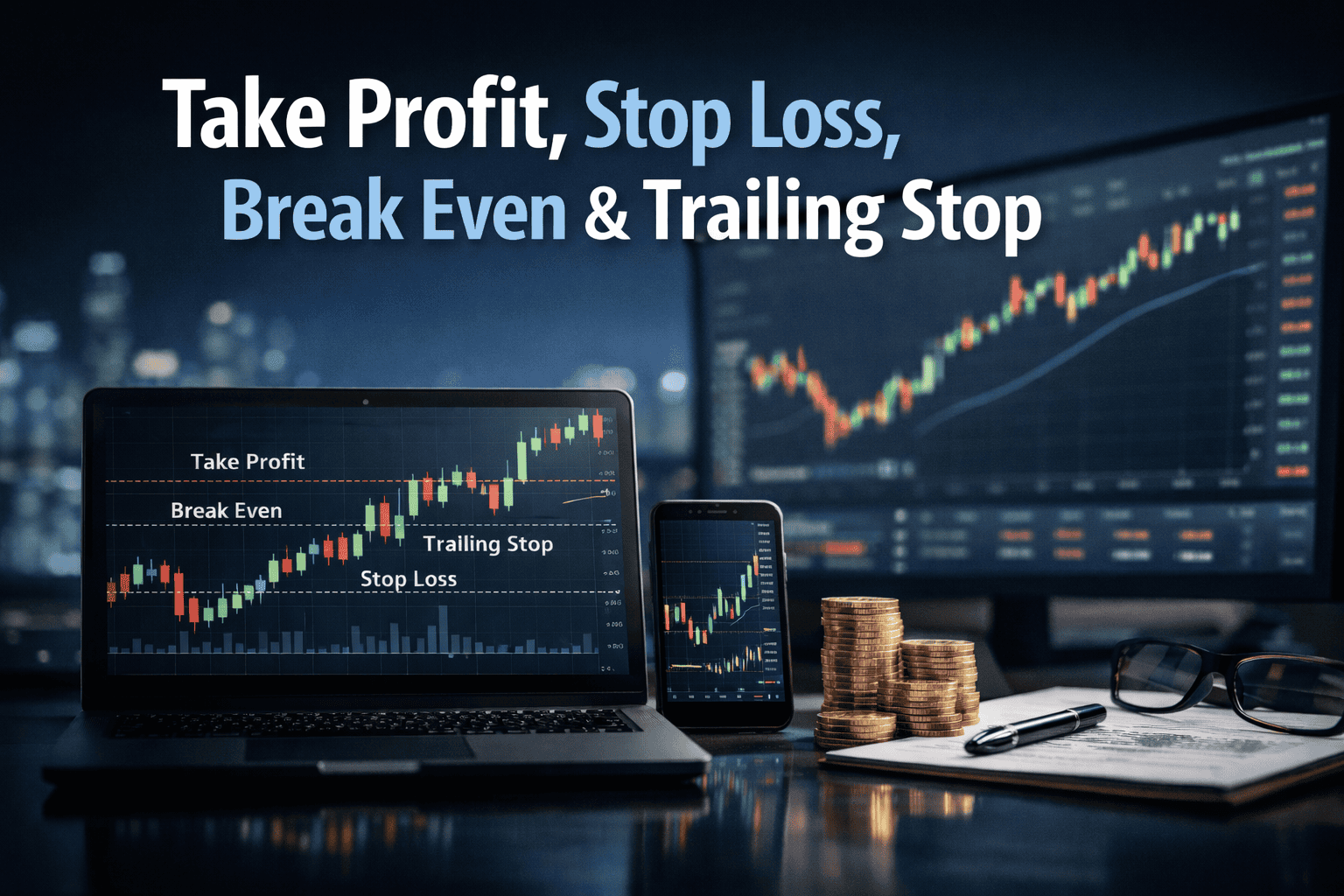
Take Profit, Stop-Loss, Break-Even, and Trailing Stop: Everything you need to know to master your exits
Good trading depends as much on entry as it does on exit. Whether you trade manually or via an MT5 robot, how you lock in your gains or limit your losses makes all the difference. In this article, we review the four main exit parameters: Take Profit (TP), Stop Loss (SL), Break-even (setting the stop at the entry price), and Trailing stop. We will look at how they work, their advantages and disadvantages, their psychological impact, and how to combine them to optimize your performance. The references cited come from recognized sources as well as our own articles on Pipmaster.
Why these tools are essential
The idea of winning without a safety net is appealing, but it is a fatal mistake. A stop-loss is a safety net that limits the potential loss of a trade and must be set before entry. Pepperstone reminds us that its greatest use is to limit how much you can lose. It also automates execution to avoid emotional decisions. Conversely, a take-profit closes a position when a target price level is reached, preventing you from becoming too greedy. These two orders constitute the first level of risk management and remain essential, whether you are swing trading, scalping, or using an Expert Advisor.
However, there are more subtle adjustments: moving your stop to break-even to ensure a "free" trade, or using a trailing stop that automatically raises your stop when the market moves in your favor. These tools provide more dynamic control but also have psychological or technical pitfalls. A thorough understanding is therefore necessary.
Stop-Loss: Definition, Advantages, and Pitfalls
A stop-loss is an order that automatically closes a position if the price reaches an unfavorable level. In our blog article Stop-loss too tight, it is described as a safety net that allows you to set in advance how much you are willing to risk. A randomly adjusted stop is dangerous: A stop that is too tight is quickly triggered by normal fluctuations, leading to a series of losses before the trend even starts. Worse still, some prop traders reduce their stops to comply with drawdown, but get knocked out just before the momentum kicks in.
Pepperstone highlights three advantages: minimizing losses, automating exits, and imposing discipline by removing emotion from the process. The disadvantages are related to volatility: a stop that is too tight can be triggered by a simple noise ("stopped too early") and there is a risk of slippage during a sudden movement. To overcome these shortcomings, it is advisable to:
- Calibrate the stop based on volatility: We recommend usingthe Average True Range (ATR) to determine the distance of the stop. A stop set at 1.5 × or 2 × the ATR takes fluctuations into account and avoids being triggered unnecessarily. In our article on ideal risk parameters, we explain how to adjust position size so that the loss corresponds to a percentage of capital (0.5% to 1%) and place a stop accordingly.
- Avoid arbitrary stops: A stop placed just below resistance or above support is often caught by wicks. It is preferable to position it below a wider support zone or according to a multiple of ATR.
Take Profit: Lock in your gains without giving in to greed
A take profit is a limit order that closes the position at a higher target price (for a buy) or lower (for a sell). It secures a profit without constant monitoring: Pepperstone gives the example of a trade on AUD/USD where a TP placed at 0.7550 allows you to earn 50 pips without staying glued to the screen. The advantages are simple: lock in profits, avoid the temptation to let the trade run, and free up time. The disadvantages? You limit your upside: if the market continues in your favor, you will not benefit from the entire movement. There is also the risk of becoming rigid. A fixed TP may be inappropriate if volatility or the context changes.
To choose an appropriate TP level:
- Use support/resistance and risk/reward ratio: A risk/reward ratio of 1:2 means that the TP is twice as far away as the stop. Our article Ideal risk parameters reminds us that FTMO recommends a risk per trade of around 1% and that an EA should aim for a target accordingly.
- Adapting to volatility: A calm market requires tighter targets, while a volatile market requires more leeway to avoid exiting too early.
- Revise along the way: An initial TP can be adjusted if macroeconomic or technical data changes the context. A dynamic exit strategy may consist of gradually moving the TP or taking partial profits.
Break-Even: Secure without frustration
Breakeven involves moving the stop-loss to the entry level (plus a few pips to cover the spread) when the position is in profit. According to Trading Heroes, this is equivalent to guaranteeing that you will not lose money: The stop is adjusted to the entry price after a favorable movement, making the trade "risk-free." This move frees up mental capital and allows you to focus on other opportunities.
Advantages of break-even
- Peace of mind: You can no longer lose on this trade, which reduces stress and frees up your attention for other positions.
- Capital management: By protecting your capital, you comply with the drawdown rules of a prop firm such as FTMO. Our article on risk parameters reminds you that a daily drawdown of 5% and a total drawdown of 10% are imposed. Breaking even on a trade helps you stay within these limits.
Disadvantages
- Premature exits: The main criticism is that you get stopped out too early and miss out on a major move. Trading Heroes explains that a stop that is moved too quickly is more likely to be hit by normal fluctuations, reducing the number of winners. A trade that has become free but is closed too early will not offset your losses.
- No universal rule: The relevance of break-even depends on trading style. Some scalping strategies use it as soon as a minimal gain is achieved, while swing or trend following strategies prefer to wait for a significant movement (for example, 1R or a first target reached). On ProfitFarmers, break-even is presented as a variant of trailing stop, with options to move the stop to different gain levels.
When and how should you break even on a trade?
- Set a profit threshold: Many traders only move their stop after reaching an initial target (Target 1) so as not to reduce potential performance. ProfitFarmers recommends waiting until a TP level has been crossed before moving the stop.
- Take volatility into account: As with the initial stop-loss, use the ATR to determine when a movement is sufficiently mature. A break-even activated too early will be useless in a "noisy" market.
- Stay consistent: Changing your method from one trade to another destroys your statistical advantage. Trading Heroes recommends defining in advance the minimum profit (1 times the risk or a percentage) that will trigger the stop move.
Trailing Stop: Let profits run
A trailing stop is a dynamic order that follows the price as it moves in your favor. SmartAsset defines a trailing stop as an order that automatically adjusts when the price rises, following a percentage or fixed value, but remains unchanged when the price falls. The sale (or purchase for a short position) is triggered if the price falls by a defined amount. The goal is to protect a gain while leaving the position open as long as the trend continues.
How does a trailing stop work?
Investopedia explains that a trailing stop "improves the stop-loss by adjusting the sell trigger as the price rises." The distance (percentage or fixed amount) is determined in advance. With each new high, the stop rises to maintain the initial spread. If the price stops rising, the stop remains at the previous level and is triggered if the price falls back. Trailing stops can be used via orders in increments (e.g., 50 pips distance) or percentages (2%). An Investopedia article emphasizes the need to study volatility and choose a gap that captures real pullbacks while filtering out noise.
Benefits
SmartAsset lists several benefits:
- Risk automation: The stop adjusts with the market and protects gains without constant monitoring.
- Preservation of profits: The selling price moves upward as the value rises, allowing gains to run.
- Emotionless decision-making: Using a pre-established rule avoids impulsive decisions driven by fear or greed.
- Effectiveness in trending markets: This tool works particularly well when the market is moving steadily in one direction.
Disadvantages
- No guarantee of execution: Once triggered, the trailing stop becomes a market order and may be executed at a less favorable price in the event of high volatility.
- Premature exit in volatile markets: Short-term fluctuations can trigger the stop before the trend resumes.
- Delicate calibration: A stop that is too tight will be triggered frequently, while a stop that is too wide will result in significant losses in the event of a reversal.
- Need for monitoring: Even though it automates exit, the trailing stop does not exempt you from monitoring the macroeconomic context and changes in volatility.
Trailing stop vs. break-even
Although some brokers use the term "break-even stop" for a simplified trailing stop, there is a difference:
- The break-even moves the stop to the entry point and does not change thereafter (unless you reposition it manually). It is mainly used to turn a trade into a "free" position.
- The trailing stop continuously evolves as the price rises and can pass through several levels (Target 1, Target 2, etc.). Profit Farmers explains that their "Break-Even Stop-Loss" option acts as a trailing stop with three modes: moving the stop one level behind the TP, two levels behind, or simply switching to the entry point.
Combining stop-loss and trailing stop: A winning approach
Investopedia recommends combining a fixed stop-loss and a trailing stop to achieve a balance between protection and performance: You can place an initial stop-loss at 2% below the price and a trailing stop at 2.5%. As the price rises, the trailing stop eventually exceeds the fixed stop and takes over. This technique gives the trade room to maneuver while protecting the gain at the same time. However, the article notes that markets can "chase stops" and that whipsaws are the main risk. To limit these erratic movements, it is best to calibrate the trailing stop using volatility (ATR) and monitor psychological levels (rounded prices) that constitute areas of resistance.
Settings for MT5 robots and FTMO challenge
At Pipmaster France, we emphasize the importance ofdynamically adjusting stops and targets in EAs. In our article on the ideal risk parameters for an FTMO robot, we reiterate the strict drawdown rules (5% daily, 10% total) and the need to calibrate the risk per trade between 0.5% and 1%. We recommend using ATR to set the stop distance and adjusting the position size so that the loss corresponding to (ATR × multiplier) equals the desired risk percentage.
The article Combining Donchian + ATR shows how ATR can be used to filter breakouts and adjust stops and targets: A stop of 1.5 × or 2 × the ATR allows you to respect volatility and avoid false signals. Our Titan Breakout EA automatically calculates volatility and allows you to adjust the stop distance, break-even level, and trailing stop size according to the market.
Practical tips and mistakes to avoid
- Avoid overly tight stops: Our article on this topic shows that stops placed without taking volatility into account lead to premature exits. Use indicators such as ATR and support/resistance levels to determine the distance.
- Maintain a favorable risk/return ratio: Aim for a minimum ratio of 1:2 between TP and SL. A ratio of 1:3 is even better for strategies with a low success rate.
- Do not move the stop backward: A golden rule is to never widen a stop to "give breathing room" to a losing trade. This turns a small failure into a catastrophe.
- Use break-even wisely: Set a threshold (1R, 50% of the target, etc.) to activate break-even and remain consistent.
- Adopt a trailing stop adapted to volatility: The higher the volatility, the wider the distance should be to avoid being stopped by noise.
- Consider slippage and liquidity: A stop order (fixed or dynamic) is converted into a market order. During a significant event, execution may occur at a less favorable price.
- Learn and test: Before applying these settings to a real account or via a robot, test them in demo mode or using backtesting. Adjust them according to your trading style and psychology.
Conclusion
Exit orders are an integral part of risk management.
Stop-loss protects your capital, take profit secures your gains, break-even turns a trade into a "free" bet, and trailing stop lets trends run while consolidating profits.
None of these tools is perfect: each has its advantages and disadvantages. Combining them intelligently, taking into account volatility, your success rate, and the rules of prop firms, allows you to get the most out of your trades.