
📉 Trading divergences: Detecting hidden market signals
Most traders look at the price.
Smart traders look at what the price hides.
Divergences are one of those discreet but powerful signals that enable you to anticipate trend reversals before anyone else.
Understanding and trading divergences is like learning to read between the lines of the market.
🧩 1️⃣ What is a divergence?
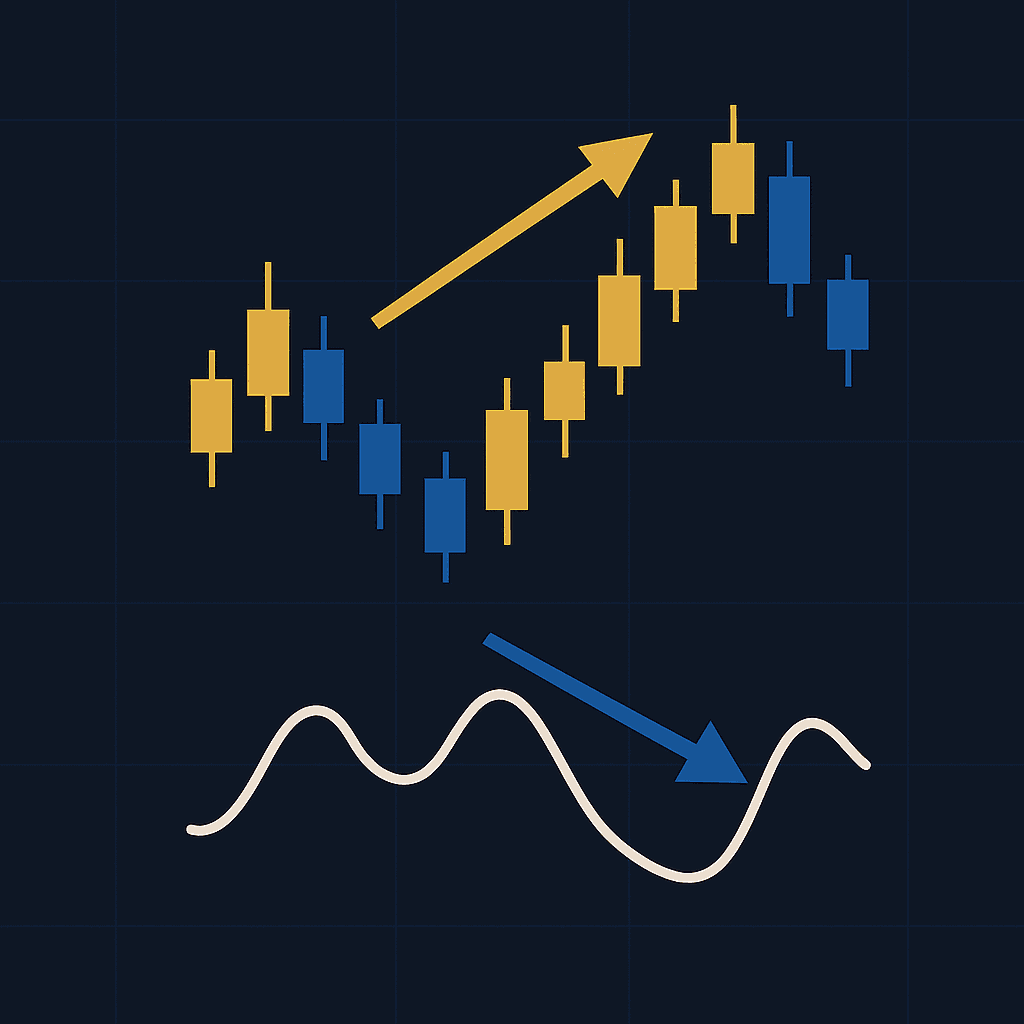
A divergence occurs when the price and a technical indicator (such as the RSI, MACD or Stochastic) are not moving in the same direction.
👉 This reflects a loss of momentum: the market continues to move forward, but without real conviction.
And often, this imbalance heralds a reversal or correction to come.
Example:
The price makes a new high, but the RSI does not confirm it.
Result: The market slows down, then finally corrects.
📊 2️⃣ The two main families of differences
🔹 Bullish divergence
The price makes a low, but the indicator makes a high.
➡️ This indicates that selling pressure is easing.
💡 Potential upward reversal signal.
🔹 Bearish divergence
The price makes a high, but the indicator makes a low.
➡️ This reflects a loss of buying strength.
💡 Signal of a possible downward reversal.
🧠 3️⃣ Indicators most frequently used to identify discrepancies
Although divergence can be observed on almost all indicators, some are more relevant:
- RSI (Relative Strength Index) → The most reliable way to spot momentum divergences
- MACD → Excellent for detecting divergences on prolonged trends
- Stochastic → Useful in range or overbought/oversold phases
💡 Tip: The higher the timeframe (H1, H4, D1), the more significant the discrepancies.
⚙️ 4️⃣ How to trade a divergence effectively
Step 1: Identify the divergence
Compares the direction of price highs/lows with those of the indicator.
Step 2: Wait for confirmation
Don't jump on the signal!
Wait for a structural break, a reversal candle or volume confirmation.
Step 3: Place your trade
- Enter after confirmation
- Position your stop loss behind the last extreme
- Sets a Take Profit based on a risk/return ratio (minimum 1:2)
Step 4: Manage position
A divergence is not always synonymous with an immediate reversal.
Think about using a break-even or a dynamic trailing stop. A method that Titan Breakout automatically applies according to volatility (ATR).
📉 5️⃣ Concrete example of divergence
Let's take EURUSD (H1):
- Price makes a new high at 1.0975
- The RSI peaked lower at 68
➡️ Bearish divergence confirmed.
After breaking a minor support, the price falls back 80 pips.
A disciplined trader places his SL just above the last peak, and secures his gains as he goes along.
Result: A rational, unhurried trade backed up by chart evidence.
🧩 6️⃣ Hidden differences: The secret of the pros
There are also hidden discrepancies, often overlooked by beginners.
They appear in trend corrections:
- Hidden bullishness: The price makes a higher low, but the indicator makes a lower low → Bullish continuation.
- Hidden bear: Price makes a high-low, but indicator makes a high-high → Bearish continuation.
💡 These hidden divergences reinforce an existing trend, rather than anticipating its end.
⚙️ 7️⃣ Titan Breakout and the management of contradictory signals
Even if Titan Breakout does not directly trade divergences, its logic indirectly incorporates them:
- EMA and ADX filters ensure that the market retains directional strength
- Le RSI H1 empêche les entrées quand le momentum est déjà épuisé (par exemple RSI > 60 ou < 40)
- Dynamic break-even locks in profits as soon as movement falters
In other words, Titan Breakout avoids the fatal divergence zones where most manual traders get trapped.
👉 Discover Titan Breakout on Pipmaster
🚀 8️⃣ To sum up
Divergences are a formidable anticipation tool, but they require :
- Patience to await confirmation
- Discipline to manage risk
- An overview of the market structure
They are not a substitute for a complete strategy, but a powerful reinforcement of it.
💡 The winning combo?
➡️ A rigorous system like Titan Breakoutcombined with your divergence analysis to filter out the most favorable contexts.