
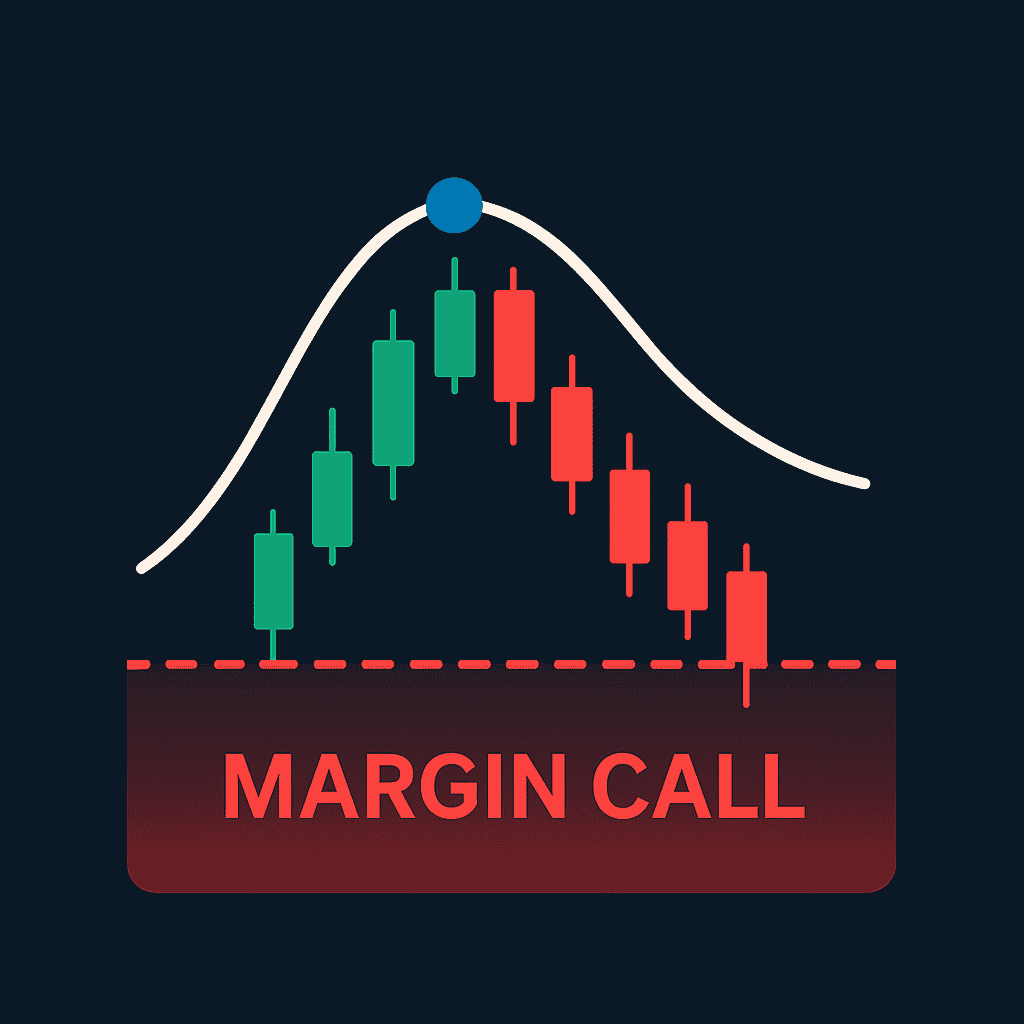
⚠️ Simple and complete explanation of margin calls in trading
Margin calls scare a lot of traders...
And yet, it's one of the most important mechanisms to understand in order to protect your capital.
A trader who has mastered margin calls understands exactly where his safety zone lies, and why certain positions can be closed automatically.
In this article, we'll clearly explain what a margin call is, how it's triggered, and how to avoid it with professional risk management.
🧩 1️⃣ What is a margin call?
A margin call is an alert from the broker that your account no longer has enough funds available to maintain your open positions.
In plain English:
Your capital is no longer sufficient to cover the potential losses of your trades.
So your broker asks you:
- To add money,
- Reduce your exposure,
- Or to close positions.
If you don't, the broker may trigger an automatic liquidation.
💣 2️⃣ The "stop out": automatic closing of positions
If your loss continues to worsen, you'll reach the stop-out level.
The stop out is the point at which the broker necessarily closes certain positions to protect his risk.
Example:
- 50% margin call
- 30% stop out
Once the stop out is reached:
➡️ The broker begins to close your positions ... even without your agreement.
The objective?
To prevent your balance from going negative.
📊 3️⃣ How is the margin calculated?
To understand margin call, you need to understand three key concepts:
🔹 Used margin
It's the part of your capital locked up to maintain your positions.
🔹 Free margin
Your available capital to open or maintain new positions.
🔹 Margin level
This is the most important figure:
Niveau de marge = (Équité / Marge utilisée) × 100
When this level falls below a threshold (e.g. 50%),
➡️ The margin call is triggered.
💡 4️⃣ Example of a margin call
Let's imagine:
- Capital: €1,000
- Position requiring €200 margin
- Your equity drops to €120
Margin level :
120 € / 200 € × 100 = 60 %
If your broker sets the margin call at 60%:
➡️ You receive the warning.
If equity drops to 50% or 40%,
➡️ Liquidation begins.
🧠 5️⃣ Why do novice traders often trigger a margin call?
There are a number of recurring causes:
- Lot too high
- Stop Loss misplaced
- No risk management
- Too many open positions at the same time
- Highly volatile market
- No margin monitoring
A margin call never happens by chance:
It's always a symptom of poor money management.
🔧 6️⃣ How can I avoid a margin call?
Here are the principles applied by professional traders:
✔️ Using a consistent Stop Loss
A SL based on the ATR avoids overly large positions.
✔️ Avoid oversizing lots
The risk per trade must remain constant and low (often 0.5 to 1%).
✔️ Limit the number of positions
Poorly controlled diversification can explode your margins.
✔️ Watch your margin level
Staying above 300% is often considered safe.
✔️ Don't trade against the trend
Prolonged trends can decimate an over-leveraged account.
🤖 7️⃣ How does Titan Breakout protect against margin calls?
This is where disciplined systems make a huge difference.
Titan Breakoutfor example:
- Automatically calculates batch size based on SL and risk
- Anti-correlation filter prevents over-exposure
- Never open multiple positions on the same symbol
- Avoid trades when volatility or spread are abnormal
- Prevents simultaneous decisions via internal mutexes
Result:
👉 The margin level remains stable, consistent and under control.
Exactly what prop firm traders like FTMO are looking for.
➡️ Discover Titan Breakout on Pipmaster
🧭 8️⃣ To sum up
The margin call is not an accident:
It is a clear signal that risk management was inadequate.
To avoid it permanently:
- Controlled batch size
- Volatility-based stop loss
- Controlled exposure
- Absolute discipline
A trader who understands margin calls becomes a more stable, lucid and professional trader.