
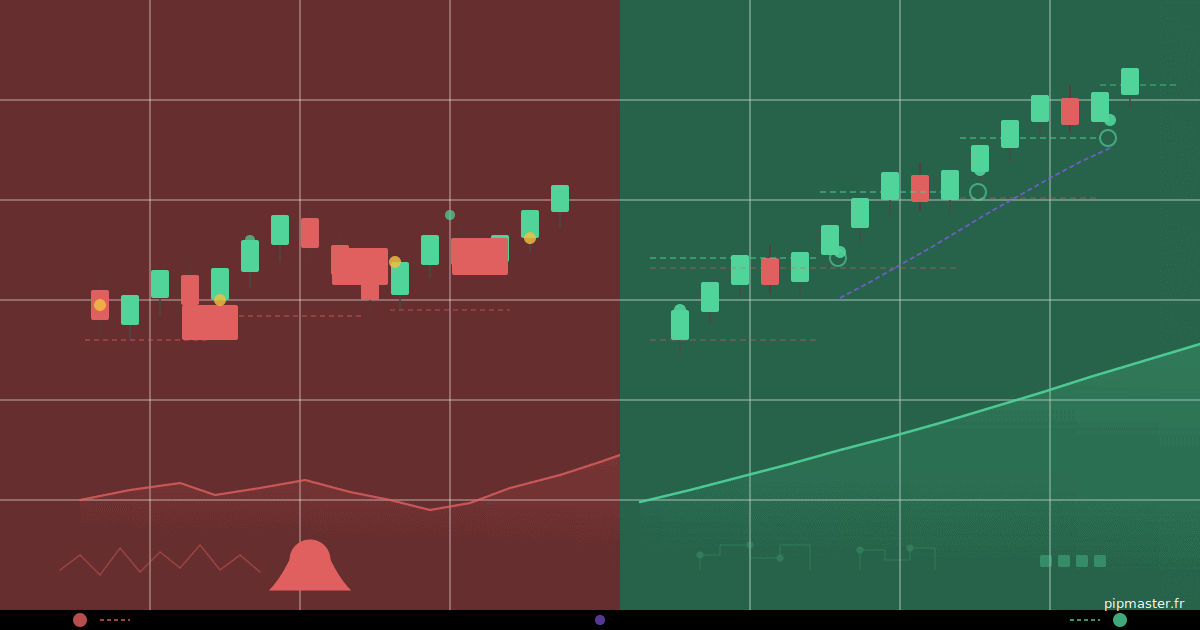
Manual Trading vs. Algorithmic Trading: Which Is Really More Profitable?
The debate between manual trading and algorithmic trading has divided the trading community for years. On one side are advocates of discretionary trading, who tout intuition, experience, and adaptability as irreplaceable advantages.
On the other hand, advocates of automated trading point to rigor, mechanical discipline, and the absence of emotions as guarantees of superior performance.
As is often the case, the reality is more nuanced than the debate suggests.
This article provides an honest analysis of the strengths and weaknesses of both approaches, backed by data, to help you make an informed decision based on your profile and goals.
Two trading philosophies, one goal
Before comparing the raw performance of the two approaches, it is essential to understand how they fundamentally differ in the way they operate.
Discretionary trading relies on the subjective analysis of a human trader:
He studies the charts, analyzes market conditions, evaluates the available information, and makes a decision to enter or exit the market in real time.
This decision incorporates a considerable amount of qualitative information that is difficult to quantify, such as analyzing order flow, gauging general market sentiment, or anticipating an imminent macroeconomic event.
Discretionary traders rely on their accumulated experience, their knowledge of financial markets, and their ability to think critically in complex and ambiguous situations.
Algorithmic trading, also known as systematic trading or automated trading, operates on a radically different principle. A set of precise and comprehensive rules is encoded into a computer program. This program continuously monitors the markets, identifies patterns that match the defined criteria, and executes buy or sell orders without human intervention at the moment of execution. No hesitation, no second-guessing, no fatigue.
The trading robot applies the same logic to its thousandth trade as it does to its first, with a consistency that even the most disciplined human cannot physically maintain over the long term.
These two philosophies do not differ in their ultimate goal, which in both cases is to generate a positive expected return in the financial markets. They differ in the means by which they seek to achieve this goal and in the nature of the obstacles they encounter along the way. Understanding these respective obstacles is key to making an honest comparison.
The Real Strengths of Discretionary Trading
Let’s start by acknowledging what manual trading actually does well, because the debate is often skewed one way or the other depending on which side is making the argument.
Experienced traders possess a contextual adaptability that current algorithms cannot easily replicate. When financial markets enter an atypical phase, when an unforeseen geopolitical event triggers abnormal volatility, or when unquantifiable information circulates in trading rooms, a well-informed human trader can decide not to trade, reduce their positions, or adjust their approach in real time.
This situational flexibility is a real strength, particularly in crisis-hit markets where historical models no longer apply.
Discretionary traders can also incorporate qualitative and macroeconomic information into their decision-making. Reading a Federal Reserve statement, interpreting the tone of a central banker’s speech, or detecting a shift in sentiment across correlated asset markets:
These are all factors that a purely technical trading program cannot directly take into account.
For fundamental or macro traders, this analytical dimension represents a real competitive advantage that pure algorithmic trading cannot replicate without a layer of natural language processing and advanced artificial intelligence.
Finally, the upfront cost of getting started with manual trading is practically zero in terms of infrastructure. All you need is a chart, a broker, and an internet connection. There’s no need to master a programming language, rent a VPS server, or pay for a license for an automated trading system.
This accessibility explains why discretionary trading remains the natural entry point for the vast majority of retail traders.
Manual trading is not inherently inferior. Its strength lies in its ability to adapt to changing conditions, its qualitative analysis of the markets, and its immediate accessibility. Its limitations stem from elsewhere: human psychology and its inevitable cognitive biases.
Why manual trading often ends up underperforming
Here’s the reality that most manual traders don’t want to admit:
Cognitive and emotional biases are the leading cause of underperformance in financial markets, far ahead of the quality of the strategy itself. Behavioral studies conducted on cohorts of retail traders consistently show that even traders with a strategy that is profitable on paper end up with worse actual results due to their decision-making behavior under pressure.
The human trader's greatest enemy is the fear of losing. This fear leads traders to take profits too early, long before the price has reached the initial target.
After a string of losses, it prompts traders to cut their losses just when the strategy might regain its statistical edge. Conversely, the lure of profit leads traders to let losing positions run well beyond the planned stop-loss level, hoping for a turnaround that never comes.
These two symmetrical behaviors, known in behavioral psychology as the “disposition effect” and “loss aversion,” automatically reduce the actual expected value of a strategy relative to its theoretical expected value.
The second major enemy of the discretionary trader is inconsistency. A human being cannot apply the same entry criteria with the same rigor at 9 a.m. after a good night’s sleep as they can at 9 p.m. after a stressful day.
Fatigue, stress, personal concerns, frustration over a previous trade: All of these factors subtly but significantly influence the quality of decisions made over time.
The problem isn't that the trader is incompetent. The problem is that he is human, with all the behavioral variability that entails.
The third obstacle is more structural: A human being’s ability to process information simultaneously is naturally limited. A manual trader can effectively monitor two or three instruments at a time.
Beyond that point, the quality of analysis deteriorates, signals are missed, and trades are executed late. This limitation makes it virtually impossible for an individual trader to effectively diversify their portfolio across multiple asset classes, whereas an automated trading program can simultaneously monitor dozens of charts across multiple time frames without ever missing a setup or delaying an execution by even a single second.
What algorithmic trading is fundamentally changing
By design, an automated trading system addresses the three structural problems of manual trading mentioned earlier.
He feels neither fear nor greed. He applies the same entry and exit criteria to his hundredth trade as he did to his first, never deviating from his defined strategy. If the stop-loss is set at twice the ATR, it will always be respected without exception, even in emotionally challenging situations where the urge to move it is strongest.
It is this mechanical consistency that constitutes the main advantage of algorithmic trading over the discretionary approach.
Discipline in execution is the most underrated aspect of algorithmic trading. There is a lot of talk about signals, indicators, and market filters. But little is said about the extraordinary value of a system that never hesitates, never questions its rules during a trade, and never allows itself to be influenced by the psychological conditions of the moment.
This mechanical discipline transforms a strategy with a slightly positive expected value into actual results that closely match the theoretical expected value. Over the long term, this makes a huge difference.
Beyond discipline, algorithmic trading offers processing and monitoring capabilities that humans simply cannot match.
A trading program such as a MetaTrader 5 Expert Advisor can run continuously, analyze every new price for each configured instrument, simultaneously apply a dozen technical and institutional filters, precisely calculate the lot size appropriate for the target risk, and execute the order in a matter of milliseconds.
This speed and thoroughness ensure that no opportunity meeting the criteria will be missed, and that no execution will be compromised by human delay at a critical moment.
Reproducibility is another key advantage. When an automated system performs well on one instrument, its settings can be applied to similar instruments with minimal adjustment.
This multi-asset strategy multiplies opportunities aligned with the strategy without increasing the trader’s workload. A manual trader who wanted to trade ten currency pairs, two indices, and two precious metals simultaneously would spend their entire days staring at charts.
A trading program manages this portfolio completely autonomously, 24 hours a day, five days a week.
To learn more about how an institutional-grade Expert Advisor manages this multi-filter, multi-asset monitoring, the page dedicated to how Titan Breakout works details the entire decision-making architecture, from trend analysis to order execution.
The main advantage of algorithmic trading isn’t the technical sophistication of its signals. It’s the absolute consistency of execution, which allows a strategy with a real edge to leverage that edge on every trade, without any deviation from its intended behavior.
The Real Limits of Automated Trading
It would be dishonest to present algorithmic trading as the perfect solution to all trading problems.
Its limitations are real, and it is important to understand them before embarking on this path.
The first limitation is inherent in the very nature of any rule-based system: A trading algorithm can only execute what has been programmed into it.
If market conditions change in a way that falls outside the parameters for which the program was designed and validated, its performance will inevitably suffer. A trading robot built on a trend-following strategy will struggle during prolonged periods of range-bound trading, just as a strategy designed for bull markets will struggle during a deep and prolonged bear market.
The second limitation is the risk of over-optimization, also known as curve fitting.
During the backtesting phase, it is technically possible to fine-tune a trading system’s parameters to the point of achieving exceptional historical performance, while creating a fragile program that will never replicate those results under real-world conditions.
An algorithm that is too finely tuned to historical data is like a car tuned for a single racetrack: it performs well in that specific context but disappoints everywhere else. The robustness of an automated system is measured by its ability to maintain acceptable performance on data not seen during optimization, not by the beauty of its backtest equity curve.
The third limitation concerns dependence on technical infrastructure. An Expert Advisor requires a stable internet connection, a reliable VPS server, a fully functional MT5 platform, and a broker with acceptable execution conditions in order to operate optimally.
A network outage, an unexpected platform update, or a broker’s maintenance window can interrupt the program’s operation at the worst possible moment. This technical dependency is an operational risk that manual traders do not face, as they can make decisions from any connected device.
Finally, understanding the underlying strategy remains essential, even when using a fully automated trading program.
A trader who deploys an Expert Advisor without understanding its underlying logic, its favorable market conditions, and its periods of vulnerability will be unable to properly assess whether a drawdown period is normal or whether it signals a structural problem.
Automation frees up time spent on execution, but it does not eliminate the need for training or an understanding of the markets.
The Question of Profitability: What the Numbers Really Reveal
Studies comparing the performance of manual traders and automated systems have reached relatively consistent conclusions.
According to data published by various regulated European brokers in their regulatory disclosure documents, between 70% and 80% of retail traders lose money in leveraged markets.
This statistic applies to the vast majority of beginner and intermediate manual traders. It is often cited as an argument in favor of algorithmic trading, but be careful how you interpret it: Above all, it indicates that trading is difficult for most people who try it, regardless of the approach they choose.
The available data on the performance of quantitative funds, however, tells a different story. Leading algorithmic hedge funds, such as Renaissance Technologies and Two Sigma, have track records spanning several decades that discretionary managers simply cannot match in terms of consistency and risk-adjusted returns.
Renaissance Technologies’ Medallion Fund is the most striking example: average annual returns of around 66% before fees over more than 30 years, free from any emotional human decision-making.
This level of performance is obviously out of reach for individual traders, but it vividly illustrates the potential of systematic trading when conducted with discipline.
When it comes to individual traders, the picture is less clear-cut. An experienced, disciplined, and methodical manual trader can very well outperform a poorly designed or improperly configured Expert Advisor.
Conversely, a robust trading program—validated using several years of out-of-sample data and implemented with rigorous risk management—will statistically outperform the vast majority of manual traders over a period of several years. The decisive factor is not the method of execution but the quality of the system, whether it resides in a trader’s mind or in the lines of computer code.
Above all, the figures confirm the importance of consistency in results.
A strategy that generates a 15% annual return with a maximum drawdown of 8% is infinitely more valuable than a strategy that yields 40% one year and loses 35% the next.
Algorithmic trading, by its mechanical nature, tends to produce more consistent performance profiles and more controlled drawdowns, as it does not take on additional risk driven by euphoria nor does it become overly conservative driven by fear.
This consistency is precisely what institutional investors and prop firms value most.
For more information on industry standards for quantitative risk management, Investopedia offers a comprehensive analysis of algorithmic trading and its applications in modern financial markets.
Comparative profitability isn’t a matter of manual trading versus algorithmic trading. It’s a matter of strategy quality, rigorous execution, and disciplined risk management. The execution method is a powerful lever, not an automatic guarantee.
Prop firms and automated trading: A natural fit
The rapid growth of prop trading firms in recent years has profoundly changed the landscape of retail trading.
Platforms such as FTMO, MyForexFunds, and The Funded Trader allow individual traders to access capital ranging from €10,000 to several hundred thousand euros, in exchange for adhering to strict risk management rules.
These rules, which impose non-negotiable daily and overall drawdown limits, create an environment in which algorithmic trading has a significant structural advantage over the discretionary approach.
The reason is simple: Prop firms prioritize consistency and risk management above all else, not absolute performance.
A trader who generates an 8% return over 30 days with a maximum drawdown of 3% will consistently be preferred over a trader who generates a 15% return but experiences capital declines of 7% or 8%.
However, maintaining this consistency over the course of a trading challenge—week after week—without ever straying from one’s rules under the pressure of losses or the euphoria of gains, is exactly what a well-calibrated trading program does naturally, whereas a human being achieves it only through considerable and inconsistent mental effort.
The drawdown kill switches built into reliable Expert Advisors also offer a decisive advantage in this context.
When a trading algorithm detects that the daily loss is approaching the limit set by the prop firm, it closes all open positions and automatically suspends any new signals for the remainder of the day.
This capital protection mechanism works without exception, even on days when a human trader’s urge to “make up” for losses is at its strongest. It is precisely in these tense moments that the mechanical discipline of an automated system truly shines and stands out most clearly from emotional trading.
The real choice: Automate your method, don’t abandon it
The dichotomy between "manual trading and algorithmic trading" frames the issue incorrectly.
The real challenge isn't choosing one or the other, but understanding how to combine them effectively.
The most successful traders over the long term are generally not those who have stopped thinking for themselves and blindly entrusted their capital to a computer program, nor are they those who insist on analyzing everything manually while ignoring the tools available to them.
These are the people who were able to identify their statistical edge, formalize their method with sufficient precision to automate it, and then delegate its execution to a system capable of applying it with flawless consistency.
This hybrid approach is actually the most common among professional traders who use Expert Advisors.
Strategic planning, market monitoring, and the decision to activate or deactivate certain instruments remain human tasks. Tactical execution, lot sizing, open position management, and capital protection are automated.
The trader combines the best of both worlds: human judgment for high-level decisions and the mechanical precision of the program for repetitive execution decisions.
An Expert Advisor like Titan Breakout is a prime example of this philosophy. Its institutional breakout strategy on the H1 timeframe, enhanced with session filters, structural levels, and Fair Value Gaps, reflects an understanding of the markets deeply rooted in the practices of institutional traders.
This program is not meant to replace the trader. It is a program that embodies the discipline and rigor that a trader should always maintain, but which human psychology makes difficult to sustain flawlessly over the long term.
For a detailed explanation of how this logic is structured and which filters are applied to each signal, the page on how Titan Breakout works answers these questions.
The philosophy behind this approach can be summed up simply:
Protect your trading capital above all else; trade less, but trade better. This discipline, applied systematically through a rigorous trading program, is the most straightforward answer to the debate between manual and algorithmic trading.
It’s not a case of one against the other. It’s human intelligence being put to use in tasks that machines do better than we do.
The real question isn’t “manual or algorithmic?” It’s “how can I formalize my method precisely enough to automate it?” Automation doesn’t replace strategy. It protects it from human errors that undermine actual results.
Conclusion
The debate between manual trading and algorithmic trading will remain unresolved as long as supporters on both sides continue to frame it as a conflict rather than a complementary relationship.
The reality of the financial markets is more pragmatic: What determines long-term profitability is the quality of the underlying strategy, the rigor of risk management, and the consistency of execution.
In these three areas, automated trading offers structural advantages that are unequivocally confirmed by the data and the experience of professional traders, particularly over long time horizons.
This does not mean that every trader should abandon their own analysis and entrust their capital to a program without giving it further thought.
This means that if you have a strategy that works, if you’ve identified a real statistical edge in the markets, automating it is probably the best investment you can make to unlock its full potential.
Becausea good strategy executed mechanically is always better than a good strategy sabotaged by emotion.